After getting well clear, a boat making penalty turns that
interrupts her turns for just the time she needs to comply with
rule 21.2 has made her penalty turns 'promptly'. When a boat
interferes with a boat taking a penalty, she breaks rule 23.2 if
she was not sailing her proper course at that time.
Facts
Boats A and B were on a beat to windward and well outside the zones of the
marks that began, bounded or ended the leg of the course on which they were
sailing. Boat B was involved in an incident with boat C, a third boat not shown
in the diagram. Immediately after the incident with C, when B was at position
1, all boats, other than A, that were racing were either further up the windward
leg than B or were far enough away from B that they could not have interfered
with B if she took a Two-Turns Penalty.
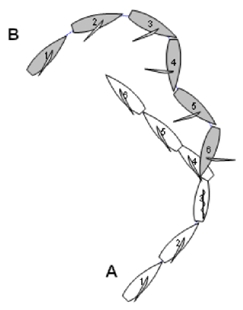
At position 1, B bore off to begin to make the turns required for a Two-Turns
Penalty. Between positions 2 and 3, A tacked onto a close-hauled starboard
tack course. At position 4, when A completed her tack, B was on a collision
course with A. Between positions 4 and 5, as shown in the diagram, B luffed
and then resumed bearing off. After position 5, B turned clockwise until she
had completed a gybe, and (not shown in the diagram) she continued her
clockwise turn until she had made a tack, a second gybe and a second tack.
Question 1
Did B break any rule?
Answer 1
No.
From position 1, when B began to bear way, through position 6, rule 21.2
required B to keep clear of A. Between positions 1 and 4 and after position 5, B
kept clear of A while bearing away. Between positions 4 and 5, while the boats
were on collision courses, B kept clear of A by luffing. Therefore, B complied
with rule 21.2.
Question 2
Did B satisfy the conditions stated in rule 44.2 for a Two-Turns Penalty?
Answer 2:
Yes.
Rule 44.2 requires a boat that takes a Two-Turns Penalty to satisfy two
conditions.
First, she had to get 'well clear of other boats as soon after the incident as
possible'. B satisfied that requirement at position 1 because
B had no basis for expecting that A would tack at position 2, and, if A had
not tacked, she would not have sailed into the space in which B was
making her turns; and
no other boat racing was in a position to interfere with B while she was
making her penalty turns.
The second condition was for her to 'promptly' make two turns in the same
direction, each turn including one tack and one gybe. Between positions 4 and
5, while B was making her turns, she interrupted her turns for just long enough
to enable her to keep clear of A as she was required to do by rule 21.2.
Immediately after she kept clear of A, B resumed her penalty turns. Therefore,
B made her penalty turns 'promptly' and, by doing so, she satisfied rule 44.2's
second condition.
Question 3
Did A break any rule?
Answer 3
The answer depends on whether or not A was sailing her proper course when B
needed to luff to avoid colliding with A.
From positions 1 through 6, B was taking a penalty and, therefore, A was the
right-of-way boat under rule 21.2. No rule in Section A applied between them
(see the preamble to Section D).
While B was taking her penalty, A 'interfered' with B as evidenced by B's need
to luff to avoid colliding with A after position 4.
If A was sailing her proper course, then rule 23.2 did not apply between A and
B. B was required by rule 21.2 to keep clear of A, and B did so by luffing.
When A changed course from close-hauled on port tack to close-hauled on
starboard tack, she was a right-of-way boat changing course and, therefore,
required by rule 16.1 to give B room to keep clear. A gave B that room, so A
broke no rule.
If A was not sailing her proper course, then rule 23.2 applied between A and B;
and, because A interfered with B, A broke rule 23.2.